China Top 10 Wire Shelving Manufacturers for Global Buyers

Time:2026-11-07 Author:Sophia
0%

China’s wire shelving sector serves warehouses, food-service facilities, retail stores, and homes worldwide. This guide introduces ten manufacturers for global buyers comparing product range, production capability, and export support. Wire Shelving may look simple, but small design choices shape its performance. Shelf dimensions, wire spacing, coating quality, and connector fit all affect daily use.

A useful supplier review goes beyond polished product photos. Buyers should request load ratings for each shelf and complete unit, plus the test conditions behind those figures. Ask whether chrome, powder-coated, or stainless-steel finishes suit the intended environment. A damp storeroom needs different protection than a dry stockroom. Check sample consistency, packaging strength, spare-part availability, lead times, and minimum order quantities. Details matter. So does communication. Clear drawings and written specifications reduce avoidable surprises, although they cannot replace incoming inspection.

The manufacturers featured here are starting points, not automatic endorsements. Capabilities, certifications, and delivery terms can change, and a company’s strongest product may not match every project. Compare evidence directly, confirm requirements with each supplier, and assess whether stated standards apply to the exact model being purchased. I may be overly cautious here, but a low quotation is not a reliable measure of long-term value. The right choice balances dependable construction, practical customization, consistent quality control, and responsive service. This overview helps buyers ask sharper questions before placing an order.
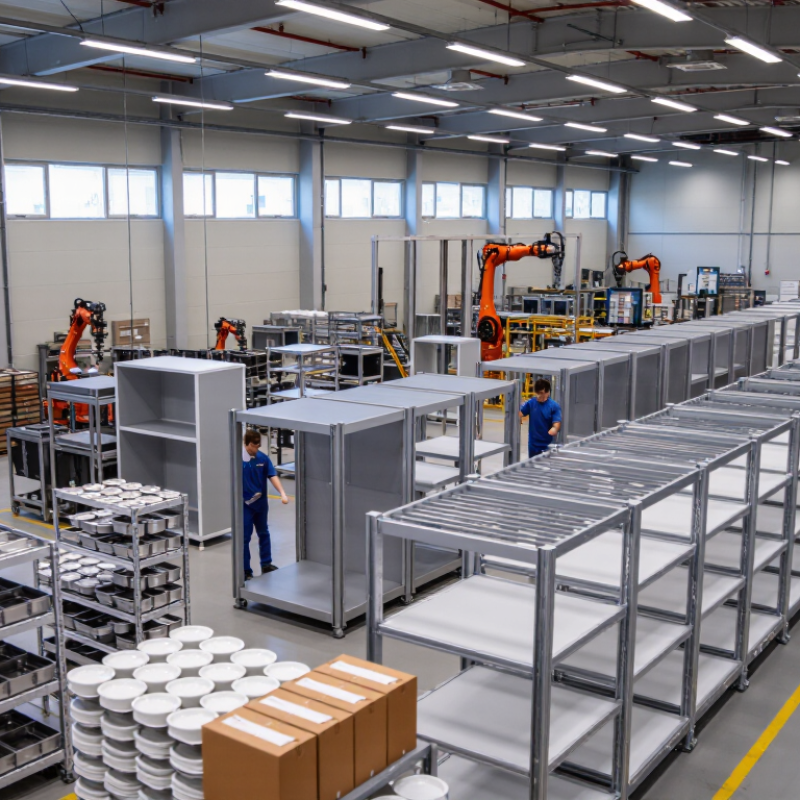
China Top 10 Wire Shelving Manufacturers for Global Buyers

Overview of China’s Wire Shelving Manufacturing Industry

China’s wire shelving industry draws strength from a deep steel-processing base, established metalworking clusters, and export-oriented production. World Steel Association data put China’s crude steel output at 1,019.1 million tonnes in 2023, about 54% of global production. That figure describes the upstream material base, not wire shelving output, so it should not be mistaken for a measure of factory capacity.

Production commonly involves wire drawing, straightening, cutting, resistance welding, and surface finishing. Buyers can inspect weld consistency, shelf dimensions, coating coverage, and load-test records. Small variations matter. A slightly uneven coating or a loose weld can become visible after repeated loading and cleaning. Finishing options often include chrome plating, zinc coating, and powder coating, with suitability depending on the intended environment.

Factories differ in automation, testing routines, and export experience; not every supplier offers the same level of process control. The World Steel Association’s figures help explain material availability, but they do not verify any individual producer’s quality. This distinction is easy to overlook. For global buyers, factory audits and sample testing provide more useful evidence than broad claims about China’s manufacturing scale. Production can be efficient, yet consistency still needs checking.

Wire Shelving Types, Materials, and Manufacturing Processes

Wire shelving is commonly made as open-grid shelves, solid-deck units, or adjustable systems with clips and posts. Open grids allow air and light to pass through, while solid decks help contain small items. The right choice depends on what the shelf will hold and how often staff need to clean it. Small parts can slip through wide gaps.

Steel is a frequent choice for strength and cost control. A zinc coating offers basic corrosion resistance; a powder-coated finish adds a smooth, colored surface. Stainless steel is better suited to damp or washdown areas, though it costs more. Finish matters. Buyers should check coating coverage around welds and cut edges, where damage may expose the base metal.

Production usually begins with wire straightening and cutting, followed by bending, welding, and surface finishing. Consistent welds help limit wobble and uneven loading, but appearance alone cannot confirm capacity. Ask for load ratings and clarify whether they apply to each shelf or the full unit. Dimensions, wire spacing, and post adjustment also deserve a sample check. I would not skip it. Drawings can look precise, yet a real shelf may reveal sharp edges or clips that fit poorly.

Wire Shelving Materials: Typical Metal Density

A comparison of typical room-temperature density values for metals used in wire shelving products and related components.

Density is a material property, not a measure of shelf load capacity. Actual product performance depends on design, wire dimensions, construction, and testing.

How to Evaluate Chinese Wire Shelving Manufacturers

When evaluating Chinese wire shelving manufacturers, examine the production process, not just the catalogue. The World Steel Association reported that China produced about 1,019 million tonnes of crude steel in 2023. That scale does not guarantee consistent wire quality. Ask for steel grade, wire diameter tolerances, and batch traceability. Request recent load-test records for the exact shelf design, including how loads were distributed and how long the shelves were tested. A heavy-looking shelf can still sag.

Check finish and repeatability. For coated products, request coating-thickness readings and corrosion-test results, including the test method and acceptance criteria. ASTM B117 describes a salt-spray test method; it does not, by itself, prove a product will last for a set number of years. Inspect welds, cut ends, and a sample carton. Small burrs matter. Packaging does too. The ISO Survey reported more than 1.2 million ISO 9001 certificates worldwide in 2022, but certification alone cannot verify a factory’s current production. Ask to see the certificate scope, then arrange a sample inspection or independent pre-shipment check. I would also compare the approved sample with goods from a later production run. This takes time, and sometimes the first sample is better than the shipment.

Profiles of 10 Wire Shelving Manufacturers in China

China’s wire shelving sector includes manufacturers with different production strengths and export experience. These ten profiles describe useful supplier types, not verified company rankings.

01 Profile one centers on custom dimensions for narrow storage spaces.
02 Profile two emphasizes chrome-plated shelves for dry indoor use.
03 Profile three offers powder-coated finishes in varied colors.
04 Profile four focuses on heavy-duty racks, where wire thickness and load testing matter.
05 Profile five supports private-label orders and customized packaging.
06 Profile six serves retailers needing consistent shelf sizes and repeat orders.
07 Profile seven specializes in kitchen and pantry storage, including baskets and hooks.
08 Profile eight makes modular systems that assemble without tools.
09 Profile nine handles mixed product ranges, which can simplify purchasing but complicate quality checks.
10 Profile ten highlights export packing and clear assembly instructions.

Check samples closely. Ask each supplier for material specifications, load ratings, finish details, and recent inspection records.

Some details remain unclear until samples arrive; even neat catalog photos cannot show weld quality or coating consistency. A shelf should sit level, with secure joints and no sharp wire ends.

Global Sourcing, Quality Standards, and Shipping Considerations

For global buyers comparing China’s top wire shelving manufacturers, sourcing begins with a clear technical brief. Specify shelf dimensions, wire diameter, finish, rated load per shelf, and the test method used to verify capacity. Ask for inspection records, coating-thickness checks, and weld samples—not just a quality certificate. ISO 9001 can indicate a documented quality system, but it does not prove that a particular rack meets your load requirements. Details matter.

Shipping deserves equal attention. UNCTAD’s Review of Maritime Transport 2024 reports that over 80% of world trade by volume moves by sea, making port schedules and freight conditions important to landed cost. Request carton dimensions, pallet plans, container-loading estimates, and a written delivery schedule before approving an order. Confirm how parts are protected from moisture and abrasion; a scratched finish or bent connector can create problems after arrival. Build in time for inspection and customs processing, because quoted transit times are not guaranteed. One point is easy to miss: the cheapest unit price may not be the lowest total cost. Packaging, replacement parts, and delayed availability can change the calculation. UNCTAD’s figures describe global trade, not any single shipment, so buyers should verify current routes and rates with their forwarder.

China Top 10 Wire Shelving Manufacturers for Global Buyers - Global Sourcing, Quality Standards, and Shipping Considerations

Supplier-neutral sourcing checklist. The entries below describe standards, documentation, and buying considerations—not verified claims about specific manufacturers or a ranked list of factories.

No. Evaluation Dimension Relevant Data or Standard What Global Buyers Should Verify
01 Base Material Wire shelving is commonly manufactured from steel wire; the grade and material condition should be stated in the product specification. Request the material grade, wire diameter, dimensional tolerances, and material test documentation where required. Do not assume that all suppliers use the same steel grade.
02 Hot-Dip Galvanized Sheet ASTM A653/A653M covers steel sheet coated by the hot-dip process with zinc or zinc-iron alloy. If coated sheet or sheet-metal components are used, confirm the coating designation and applicable specification. This standard does not by itself establish a finished shelving unit’s corrosion life.
03 Hot-Dip Galvanizing of Fabricated Parts ISO 1461 specifies requirements for hot-dip galvanized coatings on fabricated iron and steel articles. Confirm whether the standard applies to the quoted components and obtain the agreed coating requirements and inspection records.
04 Salt-Spray Testing ISO 9227 defines methods for neutral salt-spray, acetic acid salt-spray, and copper-accelerated acetic acid salt-spray testing. Agree on the test method, sample preparation, duration, and acceptance criteria before production. Salt-spray hours should not be treated as a direct prediction of years of service life.
05 Quality Management ISO 9001 specifies requirements for a quality management system; it is not a product-performance certification. Check the certificate’s scope, issuing certification body, validity, and whether the manufacturing site and relevant processes are covered.
06 Load Capacity There is no single universal load rating for wire shelving. Capacity depends on design, dimensions, material, supports, and test conditions. Request a written load rating for the exact shelf size and configuration, including whether the rating is per shelf or per unit and how the load was tested.
07 Dimensional and Finish Inspection Critical dimensions, coating appearance, weld quality, and assembly fit should be defined in the approved drawing or inspection plan. Agree on sampling, measurement methods, defect limits, and reference samples before mass production. Keep a signed pre-production sample or approved specification.
08 Minimum Order Quantity MOQ is supplier- and product-specific; custom dimensions, colors, packaging, and tooling can affect the quoted minimum. Obtain separate quotations for standard and customized products, and confirm sample charges, tooling costs, lead time, and reorder terms in writing.
09 Shipping and Trade Terms Incoterms® 2020 defines commonly used international trade terms, including EXW, FOB, CIF, and DAP. State the named place or port and the agreed Incoterm in the contract. Confirm who arranges freight, insurance, export clearance, and destination import formalities.
10 Export Packaging and Customs ISPM 15 applies to regulated wood packaging material used in international trade. Customs tariff classification depends on the product’s design and destination-country rules. Confirm carton protection, packing dimensions, pallet material, and any required ISPM 15 marking. Ask a customs broker or relevant authority to verify the correct tariff classification for the finished product.

FAQS

What types of wire shelving are available?

Open-grid shelves let air and light pass through. Solid decks help keep small items contained. Adjustable systems use clips and posts.

Which material and finish suit damp areas?

Stainless steel handles damp or washdown settings better, but it costs more. Coated steel can suit drier spaces. Check welds and cut edges for exposed metal.

How can I check whether a shelf can hold my products?

Ask for load ratings for the exact design. Confirm whether each rating applies per shelf or to the full unit. Request test details and sample the spacing.

What should I inspect on a physical sample?

Look for consistent welds, sharp edges, loose clips, and uneven surfaces. Small burrs matter. Check whether posts adjust smoothly and cartons protect the parts.

Do certificates prove that a shelf meets my requirements?

No. A certificate may describe a quality system, but it does not confirm a specific shelf’s capacity. Compare inspection records with your technical requirements.

What coating information should I request?

Ask for coating-thickness readings and corrosion-test results. Confirm the test method and acceptance criteria. A test result does not promise a fixed service life.

How can I reduce quality surprises between samples and shipment?

Compare the approved sample with goods from a later production run. Arrange an independent inspection before shipment if needed. The first sample can be better.

What shipping details affect the final cost?

Request carton sizes, pallet plans, container estimates, and a written delivery schedule. Check moisture and abrasion protection. Delays and replacement parts can change the total cost.

What details belong in a sourcing brief?

Specify shelf dimensions, wire diameter, finish, load per shelf, and test method. Include inspection needs and packaging requirements. I still find small details easy to underestimate.

Conclusion

This article explores China’s wire shelving manufacturing industry, from its production capabilities and export experience to the product choices available for different storage needs. It explains common wire shelving designs, materials, surface finishes, and manufacturing processes, helping readers understand how construction and specifications can affect durability, load capacity, and suitability for commercial, industrial, or household use.

The guide also outlines practical ways to evaluate Chinese manufacturers, including production capacity, quality control, customization options, communication, and sample assessment. Profiles of ten manufacturers provide a framework for comparing suppliers without assuming that one option fits every project. Finally, the article reviews global sourcing considerations such as confirming product specifications, checking relevant quality standards, arranging inspections, and planning packaging, shipping, and delivery timelines.

Sophia

Sophia

Sophia is a dedicated marketing professional with an exceptional depth of knowledge about her company's products and services. With a keen understanding of market trends and customer needs, she crafts insightful blog posts that not only inform but also engage readers, enriching the company’s online......